Observers moving uniformly in unified space-time in relation to objects calculate that object time in uniform-velocity direction is shorter than for relatively stationary objects {time dilation}|, and that unit time interval takes longer, so time slows down.
relativity
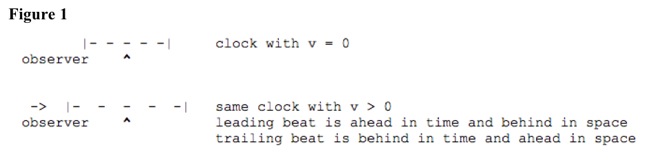
Stationary observers calculate that moving objects have shorter times than stationary objects. Moving observers calculate that stationary objects are moving and have shorter times. In both cases, observer and object have relative velocity. See Figure 1.
direction
Time dilation depends on relative transverse velocity. The radial velocity component has no effect.
distance from observer
Because transverse relative velocity is perpendicular to distance direction, distance away does not affect time-dilation ratio.
observation
When stationary observers look at moving clocks, times are not at same positions. See Figure 1.
space-time reference frame
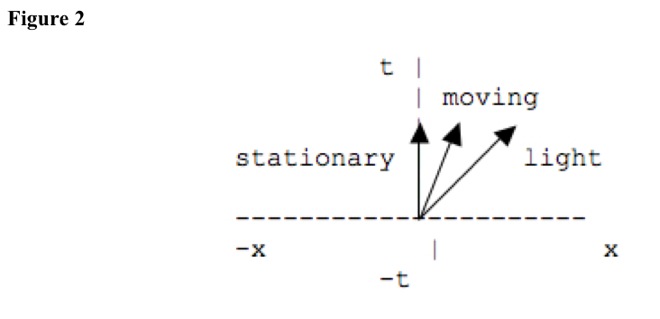
On space-time reference frames, moving events trace vectors. Stationary objects trace vectors parallel to time coordinate. See Figure 2.
space-time separation
Space-time events are separate in both time and space.
Compared to stationary clock, moving-clock first tick is behind in space and so earlier in time, and latest tick is ahead in space and so later in time. Observer calculates that object length and time are shorter. Length contraction and time dilation have same percentage, so physical laws do not change, and space-time separation is same as before. For all uniformly moving observers, physical laws are the same, and space-time separations are the same.
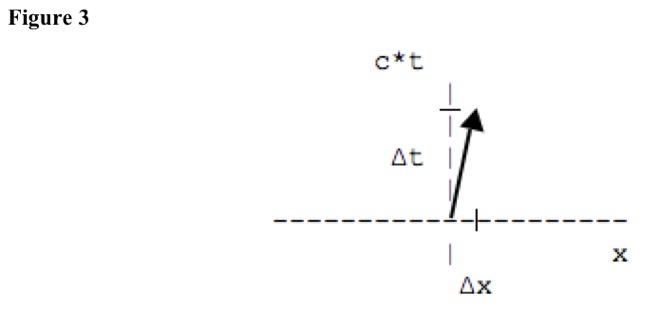
See Figure 3. In space-time, space gain causes time loss, so space-time separation s depends on space separation x and time separation t (ignoring y and z dimensions).
Because distance x is light speed c times time t, s^2 = x^2 - (c*t)^2, using distance units, or s^2 = t^2 - x^2/c^2, using time units.
For constant motion, x = v*t = (c*t)^2 - (v*t)^2 = t^2 * (c^2 - v^2) = c^2 * t^2 * (1 - v^2 / c^2). Therefore, s = c * t * (1 - v^2 / c^2)^0.5. s/c = t * (1 - v^2 / c^2)^0.5. Stationary observers calculate that moving-object time is shorter than stationary time.
time-dilation percentage
If moving object has velocity 0.5 * c (half light speed), time s = t * (1 - (0.5 * c)^2 / c^2)^0.5 = t * (1 - 0.25) = 0.75 * t.
If moving object has velocity 0.9 * c (nine-tenths light speed), time s = t * (1 - (0.9 * c)^2 / c^2)^0.5 = t * (1 - 0.81) = 0.19 * t.
If moving object has velocity 0.99 * c (99% light speed), time s = t * (1 - (0.99 * c)^2 / c^2)^0.5 = t * (1 - 0.98) = 0.02 * t.
As moving object approaches light speed, stationary observer calculates that time decreases toward zero. Stationary objects have maximum space-time separation.
maximum speed
Negative time is impossible. Therefore, nothing can go faster than light speed, and nothing can go backward in time.
time measurement
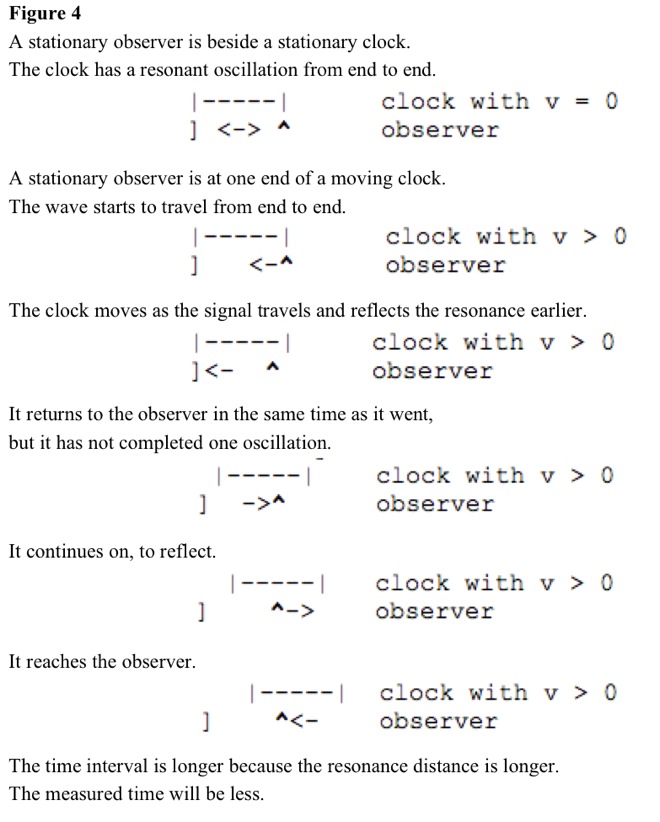
To measure stationary clocks, stationary observers observe light from clock when it reaches same resonating-wave oscillation, spin, or revolution phase. Clocks have wavelengths, frequencies, and periods. See Figure 4. Signal travels from end to end and back. Time to go is same as time to return for stationary observers. Travel time is directly proportional to length.
To measure moving clocks, stationary observers can send first-clock-beat signal to reflector at other end. Clock reflector moves closer as signal travels and reflects earlier. Observers measure that resonance cavity is longer and time interval is longer.
When moving object moves past stationary observer, one part reaches observer before other parts. Other parts lag behind in time, because they are traveling through time at less than light speed. It takes time from other parts to reach observer. Moving object goes through space faster, so lengths appear shorter. Moving object goes through time slower, so time slows. See Figure 2. At less than light speed, angle is less than 45 degrees. At light speed, angle is 45 degrees.
Frequencies are clocks. Time interval unit is time between beats or ticks, such as one second. Time is number of beats or ticks, such as 60 cycles. When time slows, frequency decreases, wavelength increases, time unit increases, and cycles decrease. Time dilation makes time unit become longer, so number of ticks is fewer, so time passes more slowly.
analogies
Time dilation is like looking at a repeating process (clock) rotated away from perpendicular to sightline. For space-time, rotation is into space dimension.
Because space-time separation has a negative sign under the square root, time dilation is like using imaginary numbers. Space-time time coordinate is like imaginary axis, so space-time is like complex plane.
Physical Sciences>Physics>Relativity>Special Relativity
5-Physics-Relativity-Special Relativity
Outline of Knowledge Database Home Page
Description of Outline of Knowledge Database
Date Modified: 2022.0224