Observers moving uniformly in unified space-time in relation to objects calculate that object mass is greater than for relatively stationary objects {mass increase}| {apparent mass} {relativistic mass}.
relativity
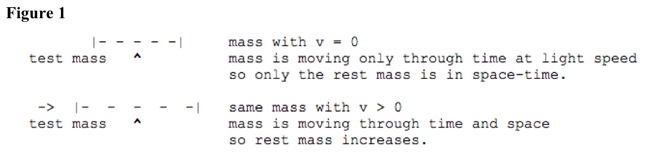
Stationary observers calculate that moving objects have greater masses than stationary objects. Moving observers calculate that stationary objects are moving and have greater masses. In both cases, observer and object have relative velocity. See Figure 1.
direction
Mass increase depends on relative transverse velocity. The radial velocity component has no effect.
distance from observer
Because transverse relative velocity is perpendicular to distance direction, distance away does not affect mass-increase ratio.
measurement
Observers measure mass using standard mass {unit mass} {mass unit}, such as one kilogram. Mass measurements use forces, energies, distances, and times. To count mass, observers measure number of unit masses.
comparison to length and time
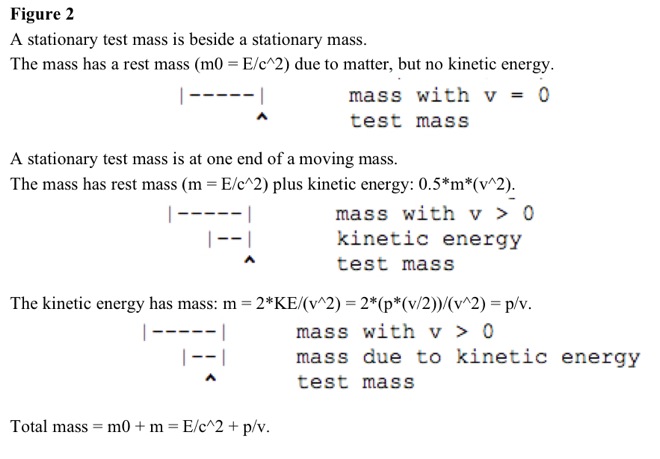
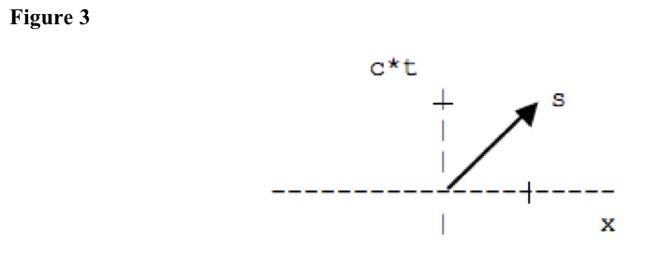
Stationary observers calculate that length contracts, time dilates, and mass increases. See Figure 2. See Figure 3.
cause
Stationary mass (rest mass) travels only through time and has no kinetic energy or potential-energy change. Moving mass travels through space (and time) and so has kinetic energy and may have potential-energy change.
Because space and time unite in space-time, momentum and energy unite. Momentum and energy both vary directly with mass. Momentum is along space coordinate, and energy is along time coordinate. As velocity increases, object moves more through space and less through time, so relative momentum increases more than velocity, so mass increases.
zero-rest-mass-particle relativistic mass and frequency
For zero-rest-mass particles, rest mass stays zero, but relativistic mass increases. Zero-rest-mass-particle energy E is directly proportional to frequency v: E = h * v, where h is Planck's constant. Zero-rest-mass-particle energy is E = m * c^2. Therefore, relativistic mass is m = h * v / c^2. Adding energy to zero-rest-mass particles increases frequency. Removing energy from zero-rest-mass particles decreases frequency.
non-zero-rest-mass particle relativistic mass
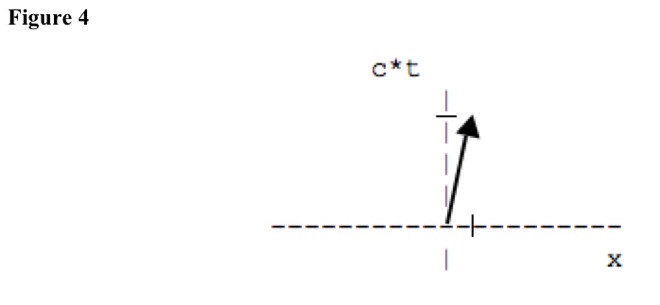
Particles with mass move through space and time, so length contracts, and time dilates. See Figure 4. Relativistic mass m is rest mass m0 plus space-dilation mass mr due to kinetic energy: mr = m0 / (1 - v^2 / c^2)^0.5. As relative velocity increases, stationary observers calculate mass increase.
Relative speed greater than 80% light speed makes object relativistic-mass kinetic energy exceed object rest-mass energy: E = m * c^2 = 0.5 * (3*m) * (0.82 * c)^2.
maximum speed
As objects approach light speed, mass increases toward infinity. As mass increases, inertia resists further acceleration, so nothing can have infinite mass or energy. No object with mass can move at light speed.
Physical Sciences>Physics>Relativity>Special Relativity
5-Physics-Relativity-Special Relativity
Outline of Knowledge Database Home Page
Description of Outline of Knowledge Database
Date Modified: 2022.0224