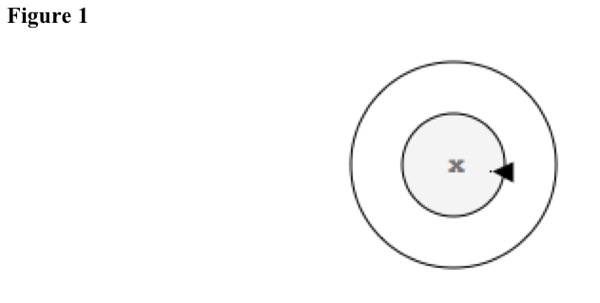
Though electrons and protons have strong electrical attraction, and outside electrical attractions and repulsions can disturb atom orbitals, electrons do not spiral into protons and collapse atoms. Because particles have matter waves, by the uncertainty principle, orbiting electrons cannot spiral into atomic nucleus {atom, stability}. See Figure 1.
waves
Particles have matter waves, whose harmonic frequencies relate to particle energy levels.
uncertainty
Waves by definition must be at least one wavelength long. Therefore, particle waves have location uncertainty of at least one wavelength. Particle waves have time uncertainty of at least one period, which is one wavelength divided by light speed. Particle waves have momentum uncertainty of at least Planck constant divided by wavelength. Particle waves have energy uncertainty of at least Planck constant divided by period. Particle waves make the uncertainty principle.
energy
By uncertainty principle, particles must move, and so they cannot have zero energy. Particles cannot have zero energy because they cannot have zero motion, because that violates conservation of both energy and momentum. Lowest particle energy is first-quantum-level ground-state energy.
orbits
Electron orbits have quantum distances from nucleus and take quantum durations to orbit nucleus. In lowest orbital, electron position uncertainty has same diameter as orbital. Electron can be anywhere in that region around nucleus. In lowest orbital, electron time uncertainty is same period as orbital rotation. Electron can be anywhere in that interval. In lowest orbital, electron is already at closest possible distance and smallest possible time.
transitions
From lowest orbital, electrons cannot go to lower orbits, because there are no lower energy levels. They cannot lose more energy, because if energy decreases then time increases, by uncertainty principle, making orbital go higher. They cannot lose more distance because if distance decreases then energy must increase, by uncertainty principle, making orbital go higher. Therefore, lowest orbital has lowest energy, smallest distance, and shortest time. Lowest orbital already includes nucleus region, so it cannot be smaller.
kinetic and potential energy
In quantum mechanics and classical mechanics, electric-field positions relate to potential energies. In quantum mechanics, unlike classical mechanics, kinetic energy cannot completely convert to potential energy, and vice versa. Kinetic energy and potential energy have minimum energy level and cannot be zero.
energy quantum
First energy quantum is difference between ground-state energy and next-highest-orbital energy. Second energy quantum is difference between next-highest-orbital energy and third-orbital energy. Energy quanta are not equal. Energy quanta decrease at higher orbitals. Energy quanta relate to wave harmonic frequencies. Higher adjacent wave frequencies have smaller energy differences.
atom nucleus
Atomic nucleus occupies only 10^-5 volume inside lowest-electron-orbital volume. Nucleus protons and neutrons have energy, momentum, position, and time uncertainty and so have ground-state energies. Nucleus protons and neutrons have quantum energy levels.
Lowest-orbital electrons and highest-orbital neutrons and protons never collide, because electrons have lower orbiting energies, and higher orbital radii, than neutrons and protons.
electron-proton collision
At high-enough energy and beam collimation, electrons can collide with atomic nuclei, because increased energy can narrow position, by uncertainty principle. Such electrons are not orbiting, so this situation is not about atom stability.
Physical Sciences>Physics>Quantum Mechanics>Waves>Uncertainty
5-Physics-Quantum Mechanics-Waves-Uncertainty
Outline of Knowledge Database Home Page
Description of Outline of Knowledge Database
Date Modified: 2022.0224