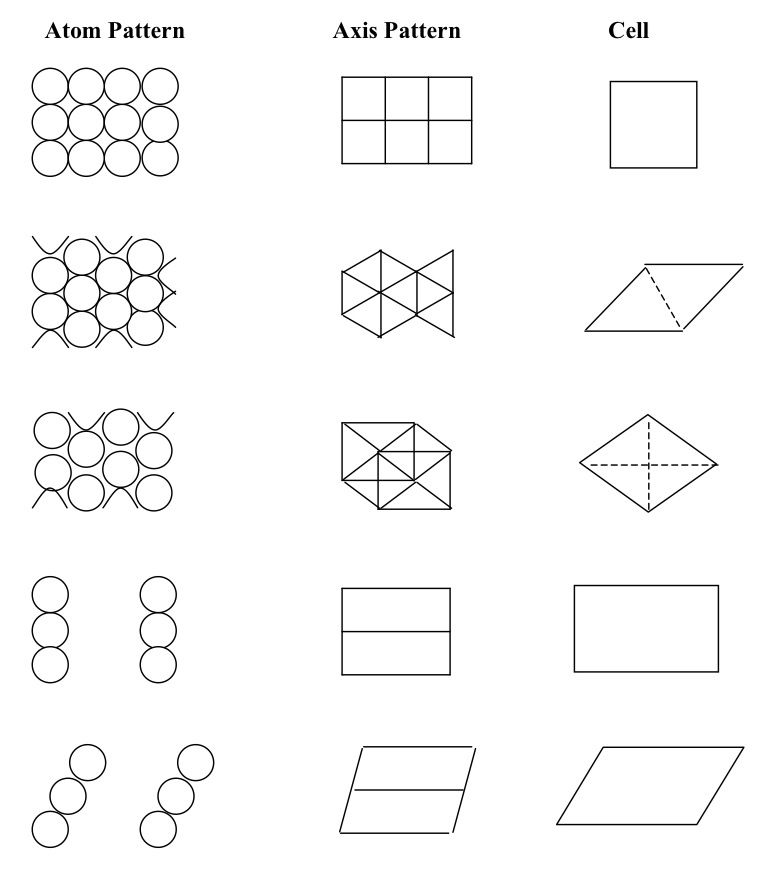
Only 14 possible arrangements {Bravais lattice} of identical spheres can make unit cells {space lattice}. Three are cubic, two monoclinic, four orthorhombic, two tetragonal, one triclinic, one hexagonal, and one rhombohedral.
Using half-unit circles as atoms, in a 3 x 4 surface area make two-dimensional figures: squares; triangles, hexagons, and rhombuses; centered rectangles; rectangles, and oblique figures.
From most symmetric to least symmetric two-dimensional space lattices (see Figure 1).
Square: Cell is a unit-length-side square, as in the first figure above. The two axes have equal length, both axes are mirror planes, and both axes have 90-degree rotation symmetry. Atoms are at corners. Cell has 90-degree rotation symmetry and two planes with mirror symmetry. Atoms have 4 atoms 1 unit away and 4 atoms SQR(2) away. Density is 12/12 = 1.
Hexagonal: Cell is a unit-length-side triangle with angles 60 degrees, a rhombus with angles 60 and 120 degrees, and a hexagon, as in the second figure above. The two axes have equal length, both axes are mirror planes, and both axes have 60-degree rotation symmetry. Atoms are at corners. Rhombus has 180-degree rotation symmetry and two planes with mirror symmetry. Triangle has 60-degree rotation symmetry and no planes with mirror symmetry. Atoms have 6 atoms 1 unit away. Density is ~13/12 > 1.
Centered rectangular: Cell is a parallelogram with angles not 30, 45, 60, 90, or 120 degrees, short diagonal unit length, and a rectangle with two sides greater than unit length and two side greater than that, as in the third figure above. The two axes have unequal length, one axis is a mirror plane, and both axes have 180-degree rotation symmetry. Atoms are at corners. Cell has 180-degree rotation symmetry and two planes with mirror symmetry. Corner atoms have 4 atoms 1 unit away, 2 atoms farther away, and 2 atoms even farther away, and central atoms have 4 atoms 1 unit away and 4 atoms farther away. Density is ~10/12 < 1.
Rectangular: Cell is a rectangle, as in the fourth figure above. The two axes have unequal length, both axes are mirror planes, and both axes have 180-degree rotation symmetry. Atoms are at corners. Cell has 180-degree rotation symmetry and two planes with mirror symmetry. Atoms have 2 atoms 1 unit away, 2 atoms farther away, and 4 atoms even farther away. Density is 6/12 = 0.5.
Oblique: Cell is a parallelogram with angles not 30, 45, 60, 90, or 120 degrees, as in fifth figure above. The two axes have unequal length, no axes are mirror planes, and both axes have 180-degree rotation symmetry. Atoms are at corners. Cell has 180-degree rotation symmetry and no planes with mirror symmetry. Each atom has 2 atoms 1 unit away, 2 atoms farther away, 2 atoms even farther away, and 2 atoms much farther away. Density is <6/12 < 0.5.
From most symmetric to least symmetric three-dimensional space lattices:
Isometric crystal: Cubic cell base is a square with angles 90 degrees, and height is perpendicular to base. All faces are squares. All axes have equal length. Atoms are at corners, can be in body center, and can be in face centers (three Bravais lattices). Point-group symmetry has three rotations by 90 degrees. For corners only, each atom has 4 atoms around in a plane and 2 atoms (above and below) along the perpendicular, total 6. For face-centered, corner atoms have 8 atoms around in a plane and 2 atoms (above and below) along the perpendicular, and centered atoms have 4 atoms around in a plane and 2 atoms (above and below) along the perpendicular. For body-centered, corner atoms have 4 atoms around in a plane, 2 atoms (above and below) along the perpendicular, and 4 atoms along diagonals, and centered atoms have 8 atoms along diagonals.
Hexagonal crystal: Cell base is a parallelogram with angles 120 and 60 degrees, and height is perpendicular to base. Two faces are parallelograms, and four faces are rectangles. Parallelogram axes have equal length, and height has any length. Atoms are at corners (one Bravais lattice). Point-group symmetry has one rotation by 60 degrees. Each atom has 6 atoms around in a plane and 2 atoms (above and below) along the perpendicular, total 8.
Tetragonal crystal: Cell base is a square, and height is perpendicular to base. Four faces are rectangles, and two faces are squares. Square axes have equal lengths, and height is not equal to square-side length. Atoms are at corners, and can be in body center (two Bravais lattices). Point-group symmetry has one rotation by 90 degrees. For corners only, each atom has 4 atoms around in a plane and 2 atoms (above and below) along the perpendicular, total 6. For body-centered, corner atoms have 4 atoms around in a plane, 2 atoms (above and below) along the perpendicular, and 4 atoms along diagonals, and centered atoms have 8 atoms along diagonals.
Rhombohedral crystal: Trigonal-point-group cell base is a rhombus, and height is not perpendicular to base. All faces are rhombuses. All axes have equal lengths. Atoms are at corners (one Bravais lattice). Point-group symmetry has one rotation by 120 degrees. Each atom has 4 atoms around in a plane and 2 atoms (above and below) along the perpendicular, total 6.
Orthorhombic crystal: Cell base is a rectangle, and height is perpendicular to base. All faces are rectangles. All axes have unequal lengths. Atoms are at corners, can be in body center, can be in base-face centers, and can be in all face centers (four Bravais lattices). Point-group symmetry has three rotations by 180 degrees and two mirror planes. For corners only, each atom has 4 atoms around in a plane and 2 atoms (above and below) along the perpendicular, total 6. For base-face-centered, corner atoms have 8 atoms around in a plane and 2 atoms (above and below) along the perpendicular, and centered atoms have 4 atoms around in a plane and 2 atoms (above and below) along the perpendicular. For all-face-centered, corner atoms have 8 atoms around in a plane and 2 atoms (above and below) along the perpendicular, and centered atoms have 4 atoms around in a plane, 4 atoms along diagonals, and 2 atoms (above and below) along the perpendicular. For body-centered, corner atoms have 4 atoms around in a plane, 2 atoms (above and below) along the perpendicular, and 4 atoms along diagonals, and centered atoms have 8 atoms along diagonals.
Monoclinic crystal: Cell base is a parallelogram, and height is perpendicular to base. Two faces are parallelograms, and four faces are rectangles. The three axes have unequal length. Atoms are at corners and can be in face centers (two Bravais lattices). Point-group symmetry has one rotation by 180 degrees and one mirror plane. For corners only, each atom has 4 atoms around in a plane and 2 atoms (above and below) along the perpendicular, total 6. For face-centered, corner atoms have 8 atoms around in a plane and 2 atoms (above and below) along the perpendicular, and centered atoms have 4 atoms around in a plane and 2 atoms (above and below) along the perpendicular.
Triclinic crystal: Cell base is a parallelogram, and height is not perpendicular to base. All faces are parallelograms. All axes have unequal lengths. Atoms are at corners (one Bravais lattice). There are no point-group symmetries. Each atom has 4 atoms around in a plane and 2 atoms (above and below) along the perpendicular, total 6.
Figure 1
Physical Sciences>Chemistry>Inorganic>Phase>Phases>Solid>Crystal>Lattice
5-Chemistry-Inorganic-Phase-Phases-Solid-Crystal-Lattice
Outline of Knowledge Database Home Page
Description of Outline of Knowledge Database
Date Modified: 2022.0224