
Visual and phenomenal spaces {space and senses} are bounded three-dimensional manifolds, with objects and events.
length units
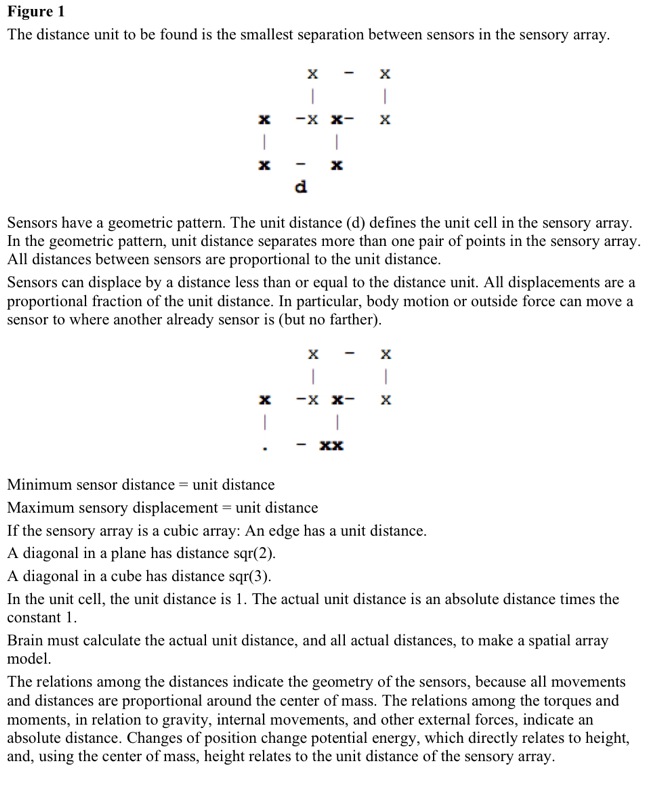
Distances between retinal ganglion cells make fundamental visual-length units. See Figure 1.
angle units
Fundamental length units establish angle units.
triangulation and distances
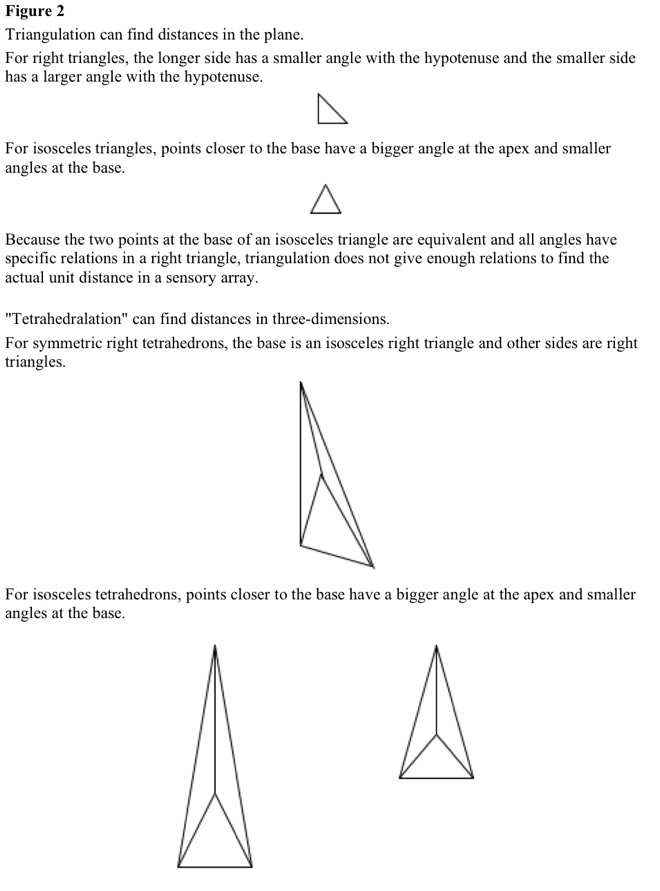
Using length and angle units, triangulation can find planar distances. See Figure 2.
intensities and distances
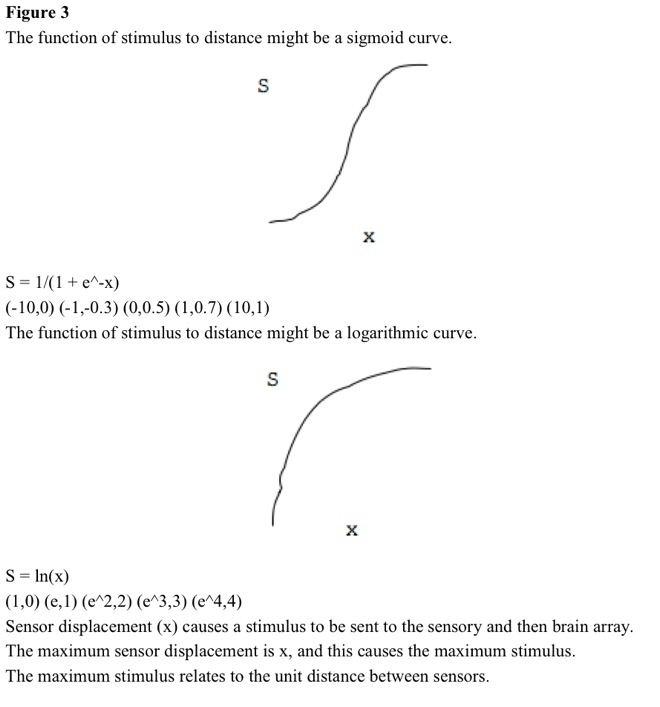
Perhaps, stimulus intensity versus distance graphs to sigmoid curve. See Figure 3.
convergence and distance
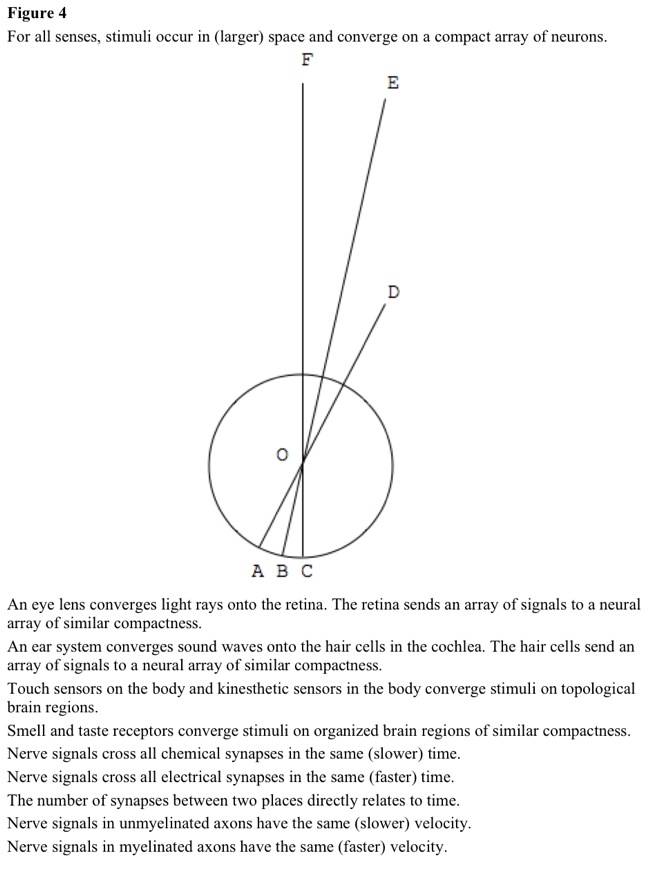
For all senses, stimuli are in larger space, and signals converge on smaller neuron arrays. See Figure 4.
translation matrix and distance
From distance information, topographic-map local neuron assemblies calculate translation matrices that place oriented surfaces away from brain at space points.
timing mechanism
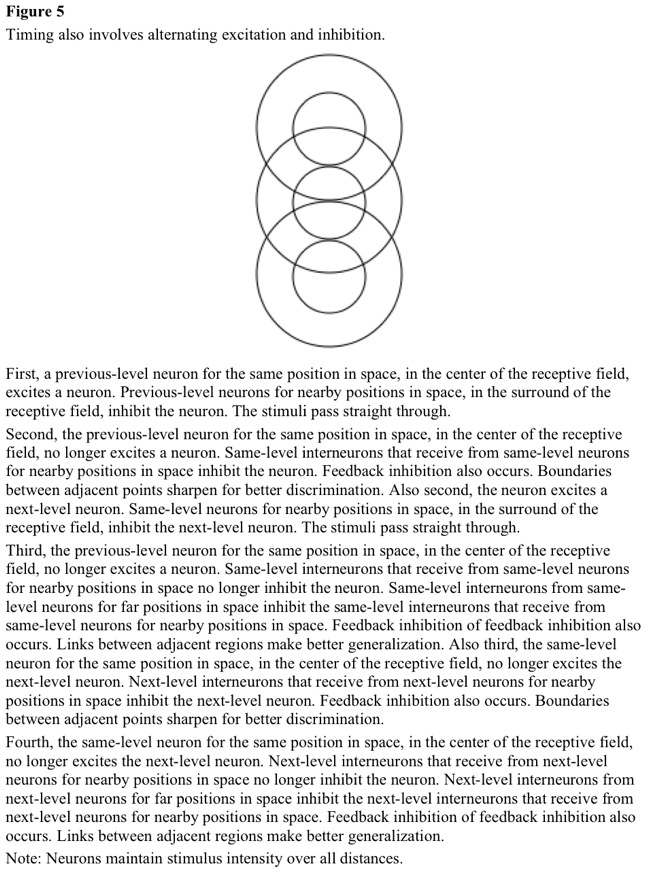
Brain timing alternates excitation and inhibition. See Figure 5.
mass center
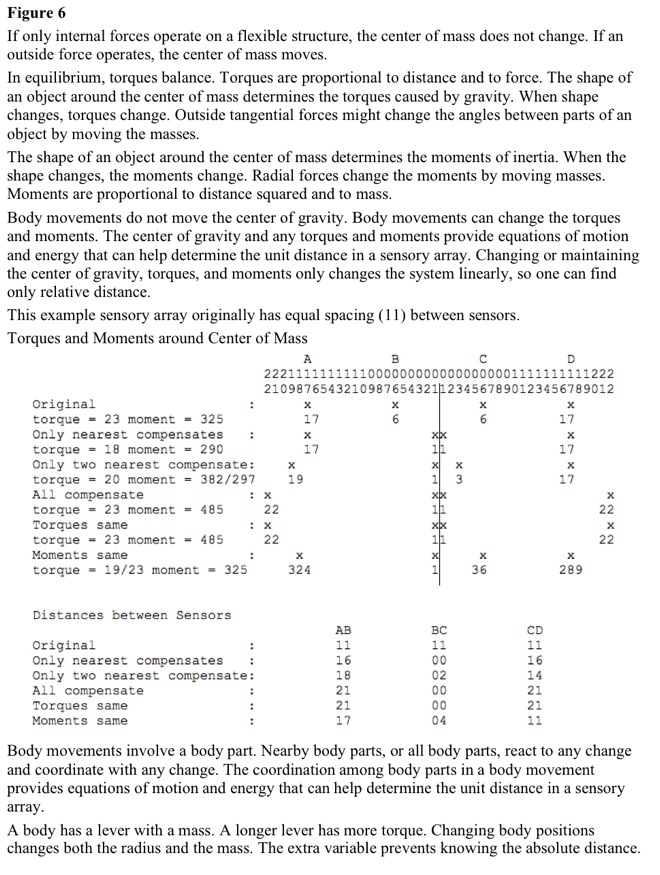
For flexible structures with only internal forces, mass center does not move. Outside forces move mass center. See Figure 6.
topographic maps
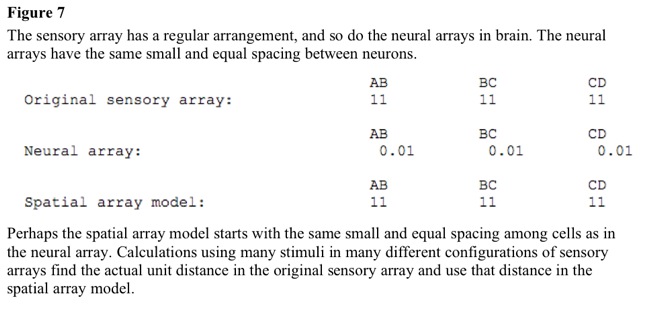
Retinal ganglion cells, thalamic neurons, and cortical neurons form arrays with equal spacing between neurons. See Figure 7.
surface orientation
Surfaces perpendicular to sightline have highest intensity. Surfaces at smaller angles have lower intensities. See Figure 8.
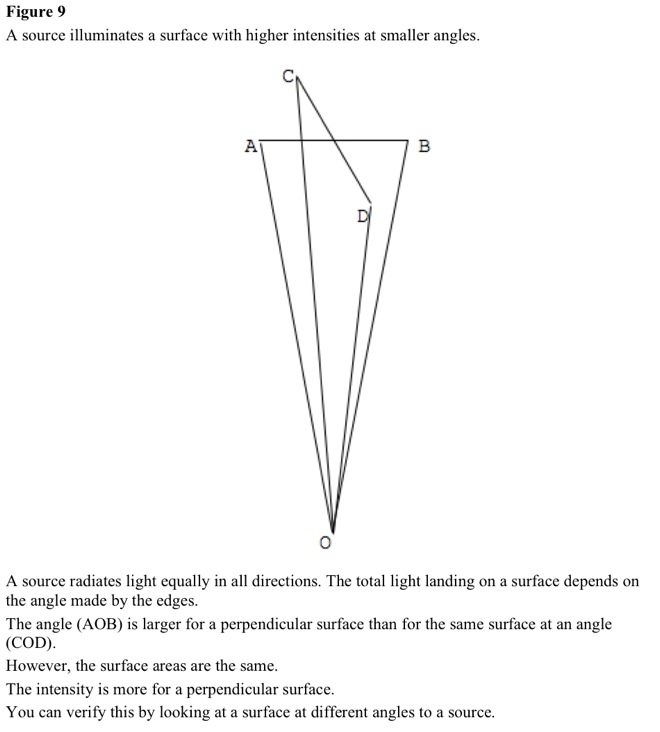
Surfaces perpendicular to light-source direction have highest intensity. Surfaces at smaller angles have lower intensities. See Figure 9.
processes: spatial and temporal relations
Modified ON-center and OFF-center neurons can detect spatial and temporal relations. For example, neuron can have horizontal band at center to detect space between two objects, band above to detect object above, or band below to detect object below.
processes: spatial layout
For positions, features, objects, scenes, and events, observing systems use object and object-property placeholder configurations to represent spatial layouts. Object and object property placeholders include smooth texture, rough texture, enclosed space, and open space. Observing systems replace object and object property placeholders with values.
Mathematical functions can represent spatial layouts. Functions with parameters or roots can describe surface and region boundaries. Waves with parameters and/or samples can describe functions and repeating or cyclic perceptions. Distributions with samples can describe surfaces and regions. Space distances and angles can describe shapes and patterns.
processes: space and time development
Body movements cause correlated sensations. As babies move body and limbs, they encounter air, fluid, and solid surfaces, including own body. For example, walking and running establish airflow gradient from front to back. Correlating sensations and movements, brain builds position and relation memories and places surfaces in body-centered space. From surfaces, brain builds horizontal ground, front and back, up and down, right and left, vertical, straight-ahead, and across. From directions and coordinates, brain learns what happens when body moves from place to place and so locates body parts and surfaces in space.
From length information, brain builds before and after memories and makes event sequences. From sequences, brain builds overall sequence and absolute beginning and end and past and future. From time coordinates, it learns what happens when it moves from time to time and locates body parts and surfaces in time.
properties: three dimensions
Midbrain tectum and cuneiform nucleus map three-dimensional space using multimodal neurons, whose axons envelop reticular thalamic nucleus and other thalamic nuclei. Spatial processing involves frontal lobe.
properties: continuity
Perceptual space never breaks into discrete parts during movement or blinking. Space has no twinkling, vibration, or oscillation. Perceptual space has no discontinuities. Visual processing is neuron size, but perceptions are much greater size. Neuron assemblies overlap and represent different sizes. Visual processes add and decay over time. Visual processing averages over time and space.
Consciousness>Consciousness>Sense
Outline of Knowledge Database Home Page
Description of Outline of Knowledge Database
Date Modified: 2022.0224