Circular color scales {color wheel} can show sequence from red to magenta.
simple additive color wheel
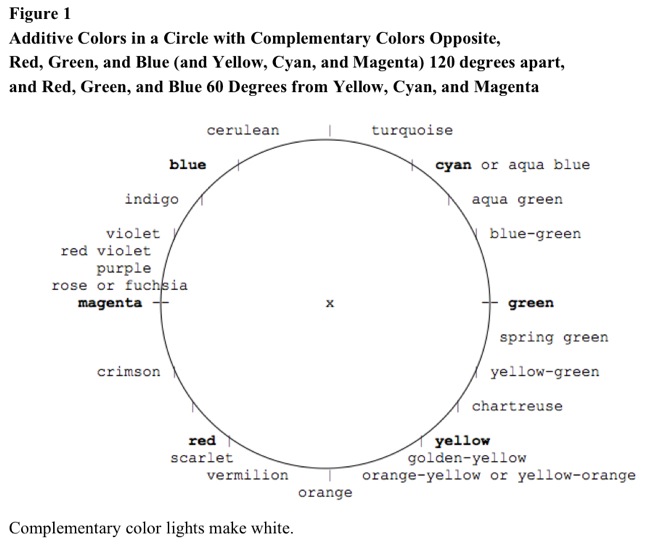
Colors on circle circumference can show correct color mixing. See Figure 1. Two-color mixtures have color halfway between the colors. Complementary colors are opposite. Three complementary colors are 120 degrees apart. Red is at left, blue is 120 degrees to left, and green is 120 degrees to right. Yellow is halfway between red and green. Cyan is halfway between blue and green. Magenta is halfway between red and blue. Orange is between yellow and red. Chartreuse is between yellow and green. Indigo or ultramarine is between blue and violet. Violet is between indigo or ultramarine and magenta. Non-spectral colors are in quarter-circle from violet to red. Cone color receptors, at indigo or ultramarine, green, and yellow-green positions, are in approximately half-circle.
simple subtractive color wheel
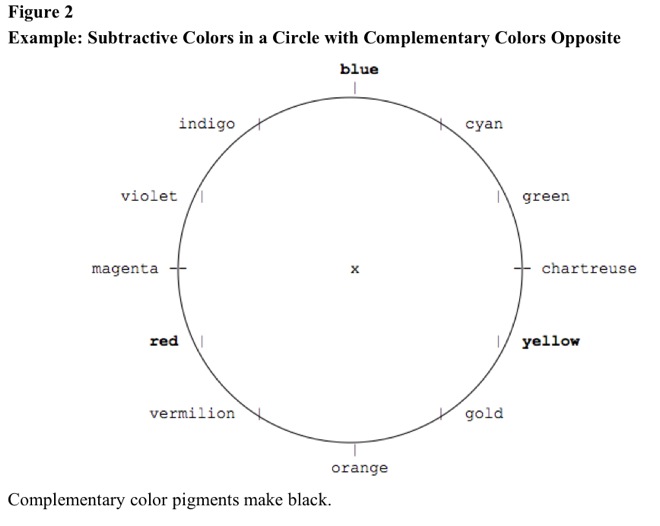
For subtractive colors, shift bluer colors one position: red opposite green, vermilion opposite cyan, orange opposite blue, yellow opposite indigo, and chartreuse opposite violet. Color subtraction makes darker colors, which are bluer, because short-wavelength receptor has higher weighting than other two receptors. It affects reds and oranges little, greens some, and blues most. Blues and greens shift toward red to add less blue, so complementary colors make black rather than blue-black. See Figure 2.
quantum chromodynamics color circle
Additive color wheel can describe quantum-chromodynamics quark color-charge complex-number vectors. On complex-plane unit circle, red coordinates are (+1, 0*i). Green coordinates are (-1/2, -(3^(0.5))*i/2). Blue coordinates are (-1/2, +(3^(0.5))*i/2). Yellow coordinates are (+1/2, -(3^(0.5))*i/2). Cyan coordinates are (-1, 0*i). Magenta coordinates are (+1/2, +(3^(0.5))*i/2).
To find color mixtures, add vectors. Two quarks add to make muons, which have no color and whose resultant vector is zero. Three quarks add to make protons and neutrons, which have no color and whose resultant vector is zero. Color mixtures that result in non-zero vectors have colors and are not physical.
color wheel by five-percent intervals
Color wheel can separate all colors equally. Divide color circle into 20 parts with 18 degrees each. Red = 0, orange = 2, yellow = 4, chartreuse = 6, green = 8, cyan = 10, blue = 12, indigo or ultramarine = 14, violet = 16, and magenta = 18. Crimson = 19, cyan-blue turquoise at 11, cyan-green at 9, yellow-orange = 3, and red-orange vermilion = 1. Primary colors are at 0, 8, and 12. Secondary colors are at 4, 10, and 18. Tertiary colors are at 2, 6, and 14/16. Complementary colors are opposite. See Figure 3.
color wheel with number line
Set magenta = 0 and green = 1. Red = 0.33, and blue = 0.33. Yellow = 0.67, and cyan = 0.67. Complementary colors add to 1.
color wheel with four points
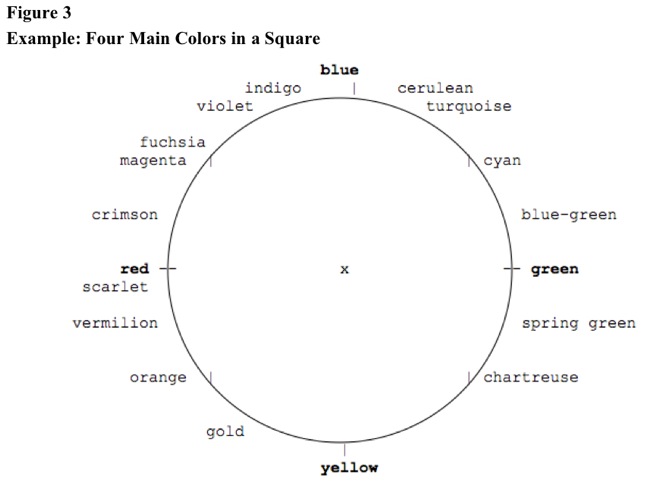
Blue, green, yellow, and red make a square. Green is halfway between blue and yellow. Yellow is halfway between green and red. Blue is halfway between green and red in other direction. Red is halfway between yellow and blue in other direction. Complementary pigments are opposite. Adding magenta, cyan, chartreuse, and orange makes eight points, like tones of an octave but separated by equal intervals, which can be harmonic ratios: 2/1, 3/2, 4/3, and 5/4.
white and black
Color wheel has no black or white, because they mostly depend on brightness. Adding black, gray, and white makes color cylinder, on which unsaturated colors are pastels or dark colors.
Consciousness>Consciousness>Sense>Vision>Color Vision>Color Space
1-Consciousness-Sense-Vision-Color Vision-Color Space
Outline of Knowledge Database Home Page
Description of Outline of Knowledge Database
Date Modified: 2022.0224